Architectural Services Proposal HTML5 Template



Edit Template Offline
2. Create new page and search for id 6494211
Edit Template Online
Create Awesome Websites


Free Nicepage Builder
Keywords
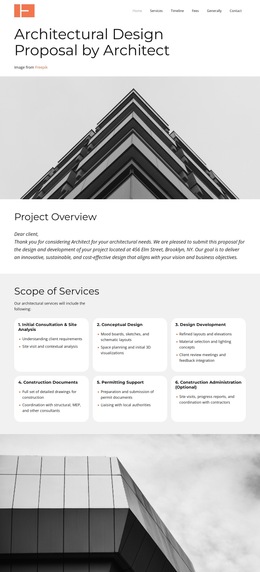
From Project Overview to Footer, the Proposal Has a Clear Hierarchy
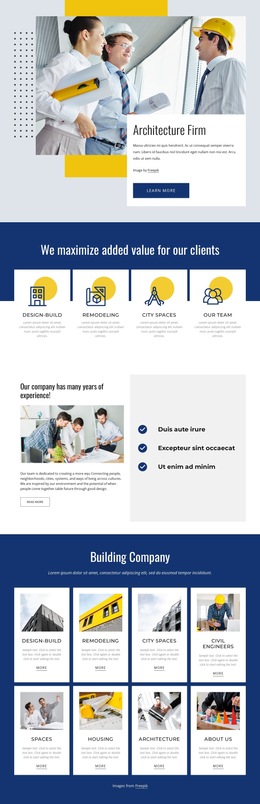
The page progresses from a compact header and title area into a Project Overview, establishing context before the six service cards define the architectural workflow. Those cards are followed by a full-width image, then a Timeline section that pairs project phases with durations. The Estimated Fees area continues the same information hierarchy by placing service and fee labels beside architectural image thumbnails. Each group therefore has a distinct role within the page rather than appearing as an undifferentiated stream of text.
The Why Choose Architect section introduces a different content pattern: a portrait is paired with five benefit cards covering experience, team, communication, sustainability, and innovation. Next Steps then narrows the visitor’s attention to explanatory text and a prominent contact button. General terms, three contact cards, and the dark footer complete the downward structure. This sequence makes the existing organization easy to inspect as a hierarchy of major blocks, repeated cards, tables, imagery, and closing information.
The design’s value as an HTML5 template comes from that visible relationship between sections and nested content roles. It does not require unsupported claims about particular semantic tags or validation standards.
Customize with Nicepage
Open this ready-made template in the HTML5 Template Builder and customize it visually in the Nicepage editor. Replace demo content, edit page sections, and adapt the design to your project without rebuilding the template from scratch.
Explore This HTML5 Template Structure
Navigate the Page Structure
Customize this ready-made HTML5 template visually in the Nicepage editor while keeping its page organization easy to understand. Use the Layers panel to view the hierarchy of the Header, Blocks, Containers, Elements, and Footer, navigate between different parts of the page, and quickly select items within the layout.
The Layers panel also provides practical controls for working with more complex pages. Blocks, Containers, and Elements can be renamed for easier identification, temporarily hidden while editing, or locked to prevent accidental changes. The outline can also expose the internal structure of elements such as Menus and Contact Forms.
Work With Organized Page Sections
Blocks divide the page into major content sections, while Containers and Elements organize the content inside them. Keeping this hierarchy visible makes it easier to understand how individual parts of the page relate to one another, especially when a layout contains many nested elements.
You can use the Layers panel to move through this structure instead of selecting everything directly on the canvas, making complex layouts easier to inspect and manage as an organized page hierarchy.
Review and Extend the HTML
After customizing the page visually, the resulting HTML can be reviewed and adapted when code-level changes are required. If a project needs additional markup or functionality beyond the standard page elements, use the HTML Element to add targeted custom HTML where necessary.
This workflow combines visual editing with a clear view of the page hierarchy, making the template useful both as a ready-made design and as an HTML5 project whose structure can be inspected, managed, adapted, and extended.

More from Architecture & Building HTML5 Templates
-
Free Website Builder SoftwareDownload