Our School Life HTML5 Template

Edit Template Offline
2. Create new page and search for id 3390152
Edit Template Online
Create Awesome Websites


Free Nicepage Builder
Keywords
Hero, Feature Cards, and Booking Create a Manageable Page Hierarchy
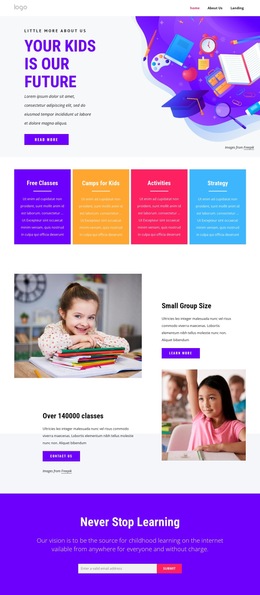
The page follows a distinct structural sequence rather than presenting unrelated visual elements. Navigation introduces Home, About, and Contact links before the first full-width Text On Image block establishes Education and Never Stop Learning. Two split sections then alternate text with circular photographs, first for the school mission and then for learning solutions. This repeated pattern gives related content a recognizable structural unit while allowing the image and text sides to mirror one another.
A classroom photograph marks the transition to four repeated learning feature cards: Fun Learning, Guaranteed Work, Resources, and Library. The next group contains three parent testimonial entries, followed by separate school-anniversary and end-of-year blocks. The green mission band acts as another clearly bounded block, while the gallery combines text panels and multiple photographs in a more varied internal arrangement.
The hierarchy becomes especially functional at the end. The class sign-up block contains date selection, available time slots, and the appointment flow, so it has a different role from the preceding informational sections. A wide footer block then closes the document. This organization makes it possible to inspect the page as connected blocks, repeated content groups, and nested visual areas. The value lies in understanding how those levels relate, not in assuming unverified HTML tags or code standards.
Customize with Nicepage
Open this ready-made template in the HTML5 Template Builder and customize it visually in the Nicepage editor. Replace demo content, edit page sections, and adapt the design to your project without rebuilding the template from scratch.
Explore This HTML5 Template Structure
Navigate the Page Structure
Customize this ready-made HTML5 template visually in the Nicepage editor while keeping its page organization easy to understand. Use the Layers panel to view the hierarchy of the Header, Blocks, Containers, Elements, and Footer, navigate between different parts of the page, and quickly select items within the layout.
The Layers panel also provides practical controls for working with more complex pages. Blocks, Containers, and Elements can be renamed for easier identification, temporarily hidden while editing, or locked to prevent accidental changes. The outline can also expose the internal structure of elements such as Menus and Contact Forms.
Work With Organized Page Sections
Blocks divide the page into major content sections, while Containers and Elements organize the content inside them. Keeping this hierarchy visible makes it easier to understand how individual parts of the page relate to one another, especially when a layout contains many nested elements.
You can use the Layers panel to move through this structure instead of selecting everything directly on the canvas, making complex layouts easier to inspect and manage as an organized page hierarchy.
Review and Extend the HTML
After customizing the page visually, the resulting HTML can be reviewed and adapted when code-level changes are required. If a project needs additional markup or functionality beyond the standard page elements, use the HTML Element to add targeted custom HTML where necessary.
This workflow combines visual editing with a clear view of the page hierarchy, making the template useful both as a ready-made design and as an HTML5 project whose structure can be inspected, managed, adapted, and extended.

More from Education HTML5 Templates
-
Free Website Builder SoftwareDownload